return to homepage

The pH Level Charts to Read Your Results

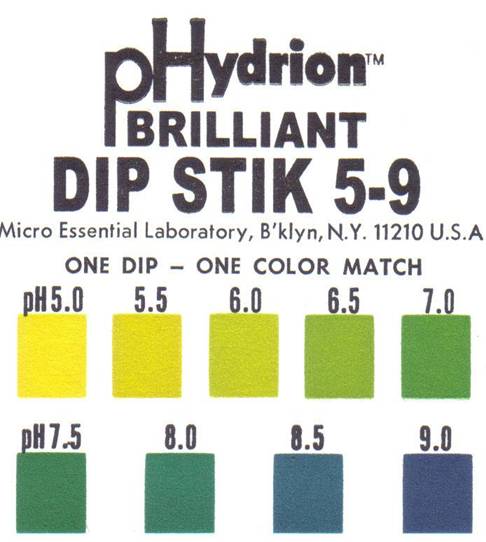
Use the pH level charts below (after reading the instructions) to compare with the pH test paper in your free pH test kit. This will identify your reading and help you to understand more about pH, and pH scales.

Instructions

It is best to do the test at least two hours after taking any food or beverage other than water. Drawing fresh saliva into the mouth and swallowing it several times before taking the test will make it more accurate.

Place the colored end of the test strip inside your mouth or in contact with a saliva sample. You can place the colored end down on your tongue and press the test strip to the roof of your mouth with your tongue. All you need is good contact for a few seconds.

Match your test strip with the pH level charts below to determine the pH of your sample. An optimal reading is 7.0 ? 7.5. Note that, due to differences in monitor settings, the color may not exactly match the original. The chart in the original kit would be the most accurate. As results can vary over a day, it is best to take several tests at different times of the day.


ph-level-charts

To help interpret your results, refer to other articles on this website.

For more information about pH, to obtain test strips or your own kit ($12.50 for 100 strips and color chart -

More pH Information

The term pH is the accepted chemical symbol meaning potential of hydrogen. Hydrogen is the first element on the periodic table and it has the symbol of H. Water (H20) dissociates into the ions H+ and OH-. Blood pH needs to be between 7.35 and 7.45 - a pretty narrow range - for you to be not simply healthy, but alive! Here are some examples of the pH of various solutions.

pH level
Examples
14
household lye
13
bleach
12
 
11
ammonia
10
 
9
baking soda (8.5)
8
sea water
7
neutral, distilled water
6
 
5
 
4
 
3
vinegar
2
 
1
 
0
battery acid

A reading of greater than 7.0 is alkaline, a reading of less than 7.0 is acid. The scale is logarithmic, so that a pH of 5 is 10 times more acidic than a pH of 6.

Why are lemons classed as an alkaline food?
The answer is that it is not the pH of the food as tested before you eat it that matters but the pH that it produces in your body after it is metabolized. Digestion is the metabolic equivalent of burning something and the pH of the ash that is left (the minerals in this case) is what determines the acidifying or alkalinizing end result of a particular food. The minerals sodium, potassium or calcium content will result in an alkaline effect. Sulphur, phosphate or chloride, will have an acidic effect. Lemons, when digested, leave an alkaline residue.


A PAIN-FREE LIFE?
Site Philosophy: Get toxins out, good nutrition in, keep moving, and your intricately-designed, self- healing body can get things working right and give you natural pain relief
Great Special
Get it Now!
heal-n-soothe
Powerful, natural pain killer and anti-inflammatory
FREE BARLEYLIFE
A $46.80 value - free with every purchase of a Thermotex infrared heating pad or Rebounder mini trampoline Best special ever!
From the web's most trusted resource for back pain, neck pain or sciatica.
back pain book
FREE BOOK - help for your back pain, neck pain, sciatica.
sleepzyme
Finally - Get A Good Night's Sleep
   
Enjoy This Site?
Then please use the button below, to add us to your favorite bookmarking service.

Subscribe To
This Site

XML RSS
Add to Google
Add to My Yahoo!
Add to My MSN
Add to Newsgator
Subscribe with Bloglines
 
Search within this web site:
Custom Search
Search the whole internet:
Custom Search

Keep up to date with
valuable insights into
pain management by
a healthy lifestyle.

Receive the monthly
Natural Pain Relief
Guide Newsletter.

News articles, health
tips, specials, freebies.

Enter your email and name
in the form to the right.
Email

Name

Then

Don't worry -- your e-mail address is totally secure.
I promise to use it only to send you Natural Pain Relief Guide News.

The contents of this site are intended for educational and information purposes only.
You have a right (and a responsibility) to educate yourself regarding health matters.
The information presented here is not meant to diagnose, prevent, mitigate, treat, or
cure any disease. If you have health concerns, consult a nutritionally-oriented health
professional and take responsibility to become educated in caring for your own health.

Return to top
POWERED BY SITE BUILD IT